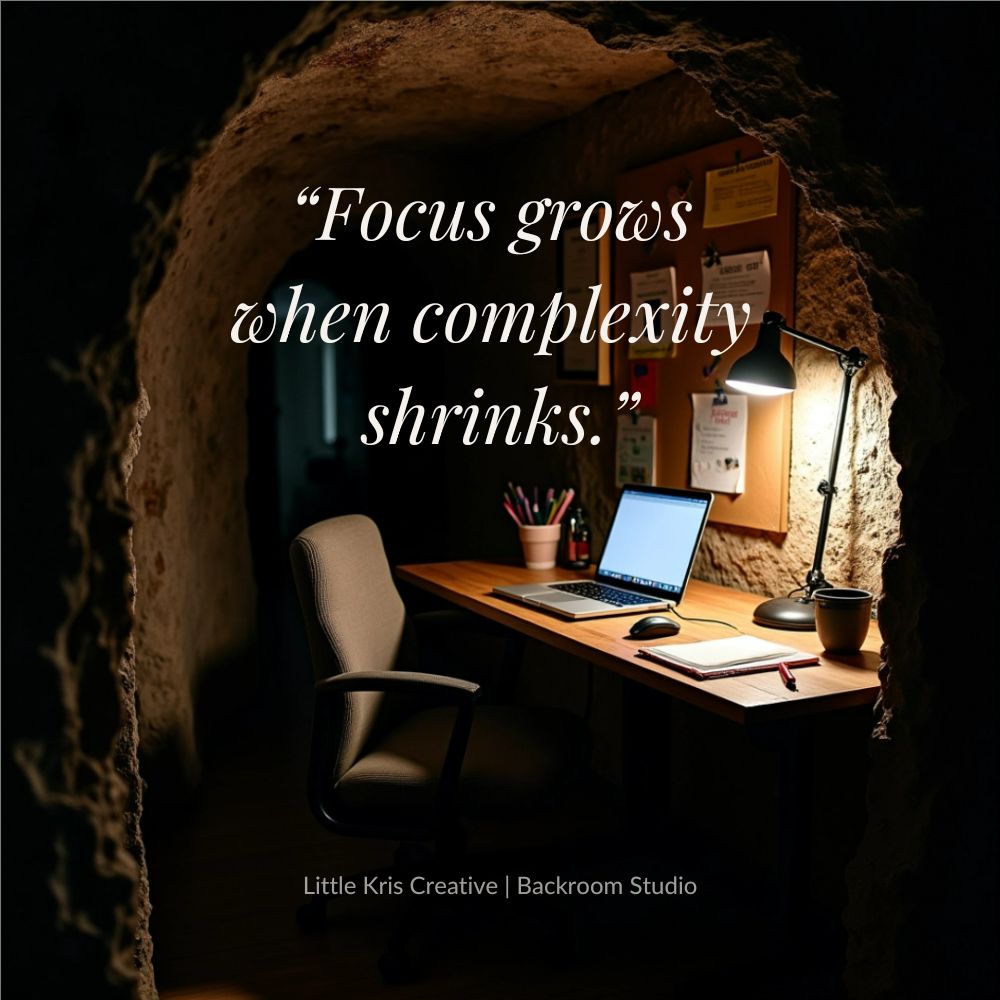
When to Simplify Instead of Adding More
Business Growth Journey
Stage 1 | Build a Strong Foundation
Week 9
When to Simplify Instead of Adding More
When business feels slow, the natural instinct is often to add something.
Another service.
Another product.
Another marketing platform.
Another piece of content.
Another strategy.
Another project.
Maybe the missing thing will finally create the momentum you’ve been looking for.
Sometimes it does.
But every new addition also creates something else.
Something to maintain.
And eventually, all those additions can make the business harder to run than it needs to be.
Every New Idea Has a Maintenance Cost
New ideas are exciting because we tend to see their possibilities first.
A new service could generate revenue.
A new platform could reach more people.
A new product could attract another type of customer.
A new marketing strategy could increase visibility.
But the initial idea is only part of the commitment.
Services need to be delivered.
Products need to be maintained.
Platforms need content.
Systems need updates.
Customers need support.
Every yes creates work beyond the moment when you say yes.
That doesn’t make new ideas bad.
It simply means they deserve to be evaluated by more than their potential.
Complexity Builds Quietly
Most businesses don’t become complicated all at once.
They become complicated one reasonable decision at a time.
You add one offer.
Then another.
You try one platform.
Then another.
You create a new process because the old one doesn’t quite work.
You subscribe to another tool because it solves one specific problem.
Each decision makes sense on its own.
Then one day you look around and realize you’re maintaining far more than you intended.
Complexity rarely announces itself.
It accumulates.
More Options Can Create More Work
We often assume more choices create more opportunity.
Sometimes they create more decisions.
More offers mean deciding which ones to promote.
More platforms mean deciding where to post.
More tools mean deciding which one to use.
More projects mean deciding which deserves attention.
Every additional option asks something from your attention.
That’s why simplifying can create an immediate sense of relief.
There are fewer things competing for a decision.
Look at What’s Already Working
Before adding something new, look at what you already have.
Which offers consistently create value?
Which marketing activities actually bring people into your business?
Which systems save time?
Which projects support the direction you’re trying to go?
Which commitments are producing something worth maintaining?
Those are clues.
Sometimes growth doesn’t require another idea.
It requires investing more deeply in the ideas that are already working.
Focus Protects Opportunity
Simplifying can feel like limiting your options.
But focus works differently.
Successful businesses aren’t successful because they pursued every possible opportunity.
They chose what mattered.
They built around it.
They intentionally ignored hundreds of other possibilities.
Focus isn’t about limiting opportunity.
It’s about protecting it.
Your strongest work needs time.
It needs attention.
It needs enough room to become better.
If everything receives a little attention, nothing receives your best attention.
Simplifying Isn’t Quitting
Business owners sometimes feel guilty about letting things go.
You started the project.
You paid for the platform.
You built the service.
You spent time learning the system.
Walking away can feel wasteful.
But keeping something simply because you’ve already invested in it doesn’t make that investment more valuable.
Sometimes the smartest thing you can do is stop maintaining something that no longer earns its place.
Simplifying isn’t giving up.
It’s choosing where your future time and attention will go.
What Would You Choose Today?
One question can make this easier.
Look at something you’re currently maintaining and ask:
If I were starting my business today, would I choose this again?
Would you still offer that service?
Would you still use that platform?
Would you still pay for that software?
Would you still run that process?
Would you still commit your time to that project?
If the answer is yes, great.
You’ve confirmed that it still belongs.
If the answer is no, that deserves your attention too.
You don’t necessarily have to remove it immediately.
But you’ve identified something worth reconsidering.
Make Room Before You Add More
New ideas aren’t going to stop appearing.
That’s probably a good thing.
Ideas create possibilities.
But possibilities don’t all need to become commitments.
Before adding the next thing, consider making room first.
Finish something.
Pause something.
Simplify something.
Remove something.
Then decide whether the new idea still deserves the space.
Growth doesn’t always come from expanding.
Sometimes it comes from creating enough room for your best work to grow.
This Week’s Reflection
Look at your current business.
Write down three things you’re doing simply because you’ve always done them.
Then ask:
If I were starting today, would I still choose to do this?
Pay attention to the answer.
You may discover that the next step forward isn’t something new.
It’s making room for what already matters.
Related Business Tool
Solopreneur Sanity Tool | Studio Edition
When too many projects, ideas, and commitments are competing for your attention, the Solopreneur Sanity Tool helps you evaluate your priorities, reduce unnecessary complexity, and focus on the work that creates meaningful progress.
Continue the Business Growth Journey
Next Week
Knowing When You’re Ready for the Next Stage
At some point, organizing and simplifying your business gives you enough of a foundation to move forward. Next week, we’ll look at how to recognize when it’s time to shift your attention from building that foundation to strengthening what you offer.
Reader Action
Make a quick list of everything you actively maintain in your business.
Offers.
Platforms.
Subscriptions.
Projects.
Processes.
Recurring commitments.
Circle the things that consistently create value.
Then choose one thing you’re maintaining mostly because you’ve always maintained it.
Ask:
Does this still deserve a place in my business?
You don’t have to remove it today.
Just answer the question.
Welcome to the Backroom. I’m glad you’re here.
I hope something you find here helps make your business journey a little easier.
I’m heading back to my cave to create. I’ll leave the light on for you.
Strategic thinking. Scrappy evolution.