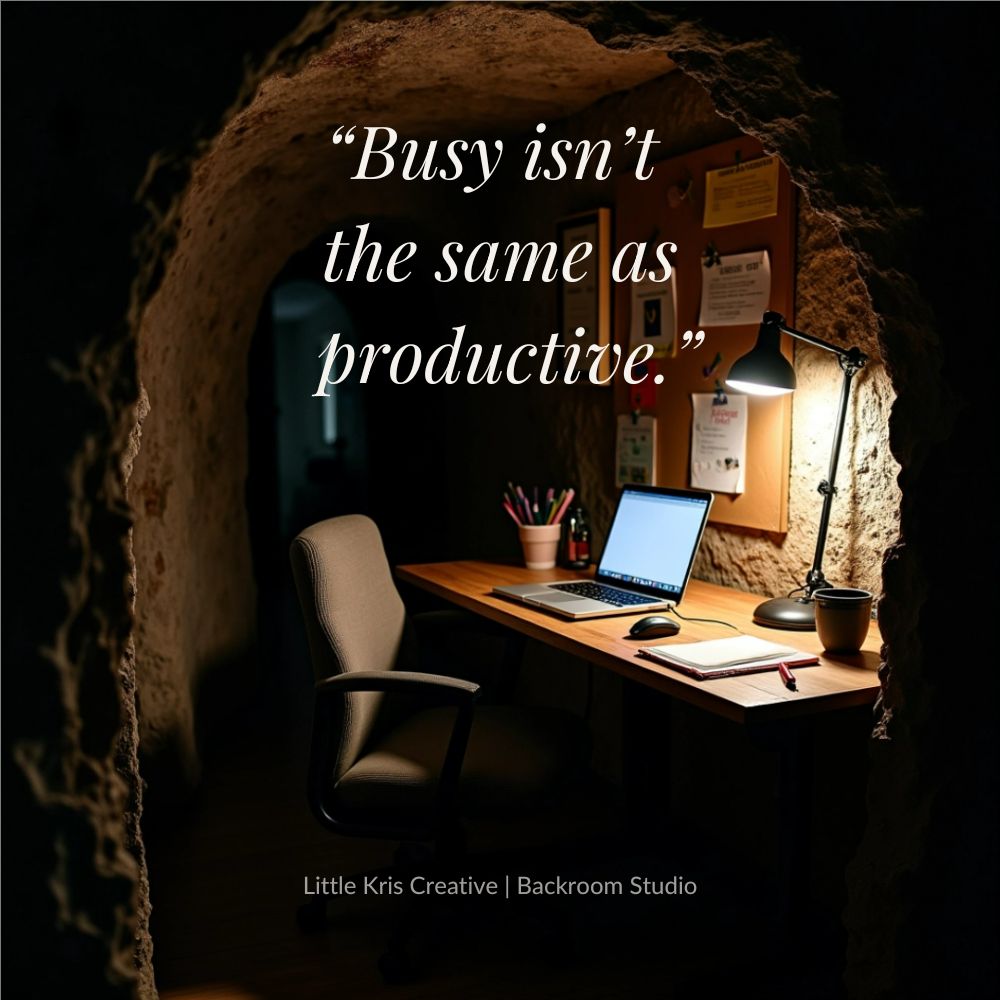
Busy Isn’t the Same as Productive
Business Growth Journey
Stage 1 | Build a Strong Foundation
Week 4
Busy Isn’t the Same as Productive
There’s a particular kind of day that can make you feel incredibly productive.
You answer emails.
Update a page on your website.
Respond to a client.
Check your analytics.
Fix something that wasn’t working.
Post on social media.
Research an idea.
Organize a few files.
By the end of the day, you’ve been working for hours.
You’re tired.
You’ve crossed several things off your list.
But when you look at your business, you’re not quite sure what actually moved forward.
That’s the difference between being busy and being productive.
Activity Feels Like Progress
Being busy feels productive because there’s visible evidence that we’re working.
Tasks get checked off.
Emails disappear from the inbox.
Notifications get answered.
Small problems get fixed.
There’s nothing inherently wrong with any of those things.
Businesses need maintenance.
The problem begins when maintenance consumes so much of our attention that there’s little left for the work that actually creates progress.
You can spend an entire week working without moving your most important priority forward.
Not All Work Has the Same Value
Every task takes time.
But every task doesn’t create the same result.
Answering an email might take ten minutes.
Making an important decision might take ten minutes.
Those ten minutes can have completely different effects on your business.
One keeps something moving.
The other might change what you do for the next six months.
That’s why productivity isn’t simply about how much you accomplish.
It’s about whether the work you’re doing supports where you’re trying to go.
Busywork Has a Sneaky Advantage
There’s another reason we gravitate toward smaller tasks.
They’re often easier.
Updating something feels easier than deciding something.
Answering an email feels easier than evaluating whether an offer is working.
Organizing files feels easier than deciding which project deserves your attention.
Small tasks give us quick wins.
Important work often requires thought.
Sometimes uncertainty.
Sometimes uncomfortable decisions.
Sometimes admitting that something we’ve invested time in isn’t working.
When that happens, busywork can become a very convenient place to hide.
Ask What Changed
One simple question can help you distinguish activity from progress:
What will be different because I did this?
Sometimes the answer is practical.
A customer received what they needed.
A payment was processed.
A problem was resolved.
Those things matter.
But other tasks create a different kind of change.
A decision gets made.
An offer becomes clearer.
A project gets finished.
A system gets simpler.
A new opportunity becomes possible.
Those are often the activities that create momentum.
Productivity Isn’t About Doing More
We tend to treat productivity as a volume problem.
How can I get more done?
How can I work faster?
How can I squeeze another task into the day?
But sometimes the better question is:
What doesn’t need my attention right now?
Removing three low-value tasks can create more progress than finding a clever way to complete all three faster.
That’s especially important when you’re running a small business.
Your time is limited.
Your attention is limited.
Your energy is limited.
Those aren’t weaknesses.
They’re resources.
And resources work best when they’re used intentionally.
Protect Time for Meaningful Work
Meaningful work doesn’t always announce itself as urgent.
That’s part of the problem.
The inbox is urgent.
The notification is urgent.
The small website problem feels urgent.
Thinking about the direction of your business rarely sends you a notification.
Neither does evaluating an offer.
Or improving a process.
Or making a decision you’ve been avoiding.
If you don’t intentionally make room for that work, smaller demands will happily consume the time instead.
A Productive Day Can Be Surprisingly Small
Some of the most productive days in business don’t produce a long list of completed tasks.
You might make one decision.
Finish one important project.
Solve one problem that’s been creating five others.
That may not look impressive on a checklist.
But it can change what happens next.
Productivity isn’t measured by how exhausted you are at the end of the day.
It’s measured by whether your effort created meaningful progress.
This Week’s Reflection
Look at what you worked on yesterday.
Not what you intended to work on.
What you actually spent your time doing.
Now ask:
Which of those things genuinely moved my business forward?
You may discover that some of your busiest activities aren’t your most valuable ones.
That doesn’t mean they all need to disappear.
It simply means they shouldn’t automatically get your best attention.
Related Business Tool
Solopreneur Sanity Tool | Studio Edition
When everything on your list seems important, the Solopreneur Sanity Tool helps you sort through competing priorities, separate meaningful work from distracting busywork, and identify where your attention can make the greatest difference.
Continue the Business Growth Journey
Next Week
Before You Make Your Next Big Business Decision
Important decisions deserve more than a quick reaction. Next week, we’ll look at the questions worth asking before you commit your time, money, or attention to your next move.
Reader Action
Before you finish work today, look at your current task list.
Choose the three things taking the most time or attention.
Beside each one, write:
What will be different because I did this?
If you can’t identify a meaningful result, ask whether that task really deserves your attention right now.
Then choose one piece of work that will genuinely move something forward.
Start there.
Welcome to the Backroom. I’m glad you’re here.
I hope something you find here helps make your business journey a little easier.
I’m heading back to my cave to create. I’ll leave the light on for you.
Strategic thinking. Scrappy evolution.